July 28, 2026 · coastal
Salt air, condenser coils and long run times
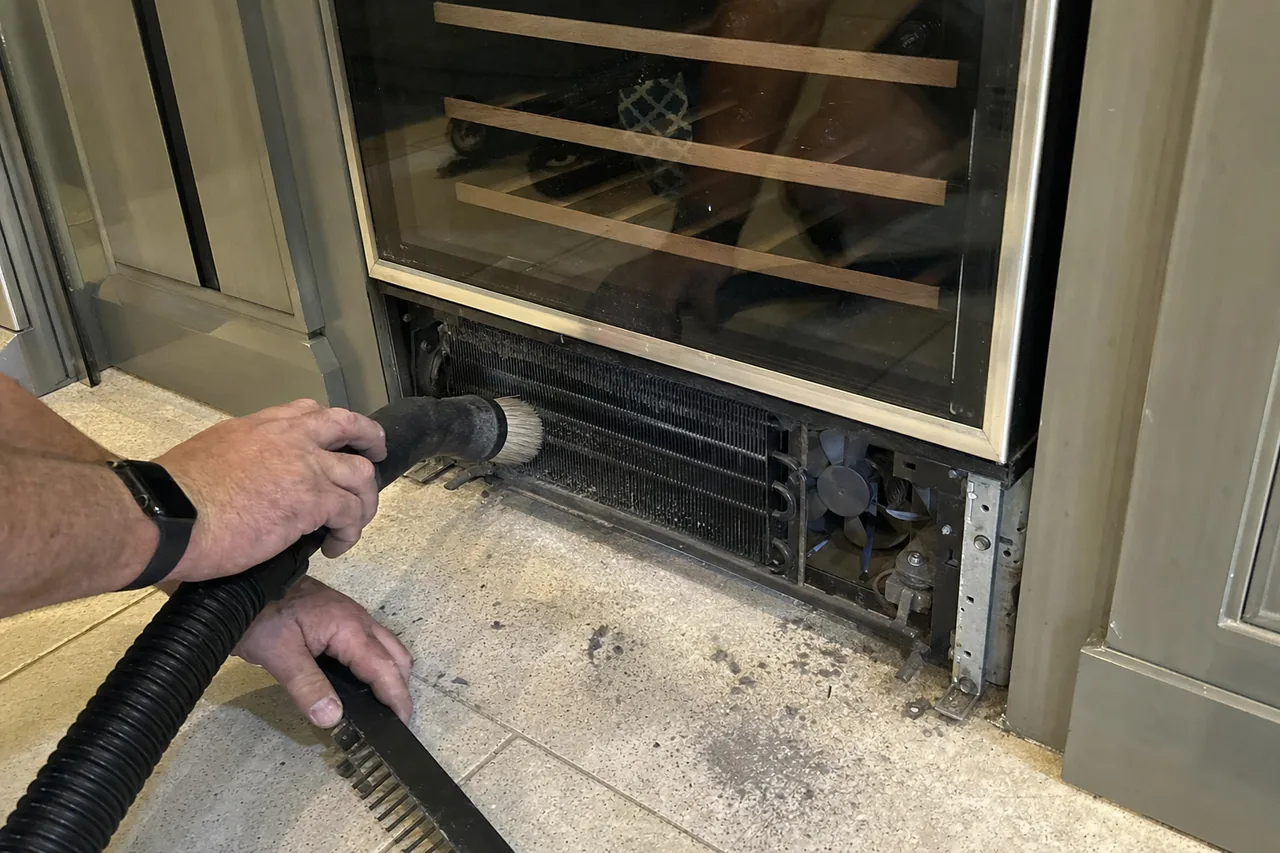
A refrigerator that runs longer than it used to is the most under-reported fault in coastal kitchens, because nothing has actually broken. The food is cold. The lights work. The only evidence is a compressor that stops less often than it did two summers ago, and almost nobody is listening for that.
The mechanism
A condenser rejects heat by moving air across a coil. The fins that carry that heat are aluminium, and aluminium exposed to salt-laden air develops a white oxide bloom that grows into the gaps between fins. Two things happen at once: the coil’s surface area is buried under a poor conductor, and the airflow path narrows. The system compensates the only way it can, by running longer to move the same amount of heat.
Left alone, that compensation is expensive rather than immediately harmful. Higher head pressure, a compressor with less off-time to cool down, and a condenser fan working against restriction — none of it trips a fault, and all of it shortens the life of components that are far more expensive than a coil cleaning.
Reading the symptom correctly
The trap is that long run times look like a refrigerant problem, and a refrigerant problem is a sealed-system job. Before anyone opens a sealed system, the cheap explanations have to be eliminated in order: a restricted or corroded condenser, a fan that has slowed or stalls when hot, a blocked grille intake, and door seals that are letting warm kitchen air in.
Two rough checks anyone can do. First, look at the condenser through the grille with a torch: clean fins look like fins, and corroded ones look like felt. Second, note whether the cabinet still recovers normally after the doors have been open a while. A unit that recovers slowly but steadily is usually fighting airflow. A unit that will not recover at all is a different conversation.
Why it is not the same as dust
The distinction matters because it changes what cleaning can achieve. Dust is a mechanical obstruction. It sits on the fins, it comes off, and the coil underneath is the coil you started with. Chloride corrosion is a chemical change to the metal itself: the bloom is aluminium oxide and chloride compounds formed out of the fin, not deposited on it.
So a coil clean on a Ponte Vedra unit does two different jobs with two different success rates. It removes the loose deposit and the lint bound up in it, and that genuinely restores airflow. It does nothing whatsoever about the fin surface that has already converted. The practical consequence is that interval matters far more than technique — the cleaning you did last spring is worth more than the more thorough one you will do in three years.
Salt is also hygroscopic, which is why this happens continuously rather than only when it rains. A fin pack carrying chloride holds moisture against the metal through every humid night, and on this coast that is most of them.
Where the gradient sits
Exposure is not uniform across a two-mile strip. It is heaviest at the dune, falls off behind the first line of buildings, and falls off again behind the marsh. Two identical units, one in a beachside villa and one three miles west in Palm Valley, will not be in the same condition after five years, and the difference is large enough to change the recommendation rather than just the wording of it.
The exception is anything installed outdoors, which takes the beachside dose regardless of how far inland the house is, because nothing stands between it and the air.
What the interval should be inland versus here
The general advice for condenser cleaning is annually. Within a mile of the Atlantic that is not enough, and twice a year is closer to right — more if the unit sits on an open pool deck, where it gets salt and humidity with no building envelope in between. Corrosion that has already set into the fin pack does not brush out; at that stage the honest answer is that cleaning restores some of the airflow and none of the metal.
We are an independent shop and we work on Sub-Zero only, which means we see the same coil, in the same air, several times a week. That is the whole reason we mention the condenser on calls that started out about something else.
What it costs
What does a Sub-Zero condenser repair cost in Ponte Vedra Beach?
Most of this work lands between $250 and $2,340, parts and labour together, and the visit that decides which end of that you are at is a flat $80 credited to the repair once you approve it. The firm number is written down after the diagnosis, not guessed at over the phone.
| Work | Typical range |
|---|---|
| Diagnostic visit | $80 flat, credited to the repair |
| Compressor or sealed-system repair | $860–$2,340 parts and labour |
| Evaporator or condenser fan motor | $250–$580 parts and labour |
Written estimate before anything is opened up. The invoice carries one number; a band is what can honestly be published before the cabinet is open. The full table is on the pricing page.
Customer reviews
Visits behind this note
4.8 out of 5 from 67 customer reviews. Each one below is a single visit, described by the person who paid for it.
Our built in held the freezer at zero but the produce was freezing too. A damper flap had cracked and was stuck open. He replaced the damper assembly and let the cabinet settle before rechecking both sides.
Nadia F.2026-04-24
Our unit ran nonstop and the kitchen floor beside it was warm. The condenser was packed with dust and salt film. He cleaned it, measured the compressor draw afterward, and it now cycles off like it used to.
Priya N.2026-06-30
The door alarm kept sounding with the door shut. It turned out to be a magnetic reed switch in the hinge column. The part sat on back order for a week, which was frustrating, but the fix itself was quick.
Colin W.2026-06-11
Questions we get asked
About Sub-Zero condenser repair
- What does a Sub-Zero condenser repair cost in Ponte Vedra Beach?
- Most of this work falls between $250 and $2,340, parts and labour together: compressor or sealed-system repair runs $860–$2,340 and evaporator or condenser fan motor runs $250–$580. Which band your cabinet is in is what the diagnostic settles, and the figure on the written estimate is the one you are asked to approve.
- Is the $80 diagnostic charged on top of the repair?
- No. The $80 covers the visit and the whole diagnostic sequence, and it comes off the repair the moment you approve the work. Decide against it and the diagnostic is all you have spent: the written findings are yours to take anywhere you like. 90 days on labour, 365 days on parts, and genuine OEM parts on every repair.
- How can a coil be blinded if it looks clean from the front?
- Because the mat forms between the fins rather than on the face of them. Salt film holds fine dust where airflow is slowest, deep in the pack, and the visible face stays presentable while the flow through it collapses. The reading that settles it is compressor draw, not a torch.
- Does corrosion on the fins mean the unit is finished?
- Not by itself. Aluminium that has bloomed white is losing surface area and will keep losing it, which shortens the cleaning interval rather than ending the appliance. What matters is whether the tube work behind the fins is sound, and that is what gets assessed.
Related