Service
Sub-Zero integrated column repair
Service for integrated refrigerator and freezer columns — the panel-ready cabinets that disappear into the joinery and hide their own air intake behind it.
Symptoms we hear most
- One column holds temperature perfectly while the one beside it drifts warm
- Frost forming along the top of a freezer column's drawer fronts
- A door that no longer sits flush with the cabinetry around it
- The door-ajar alarm sounding when the door is plainly closed
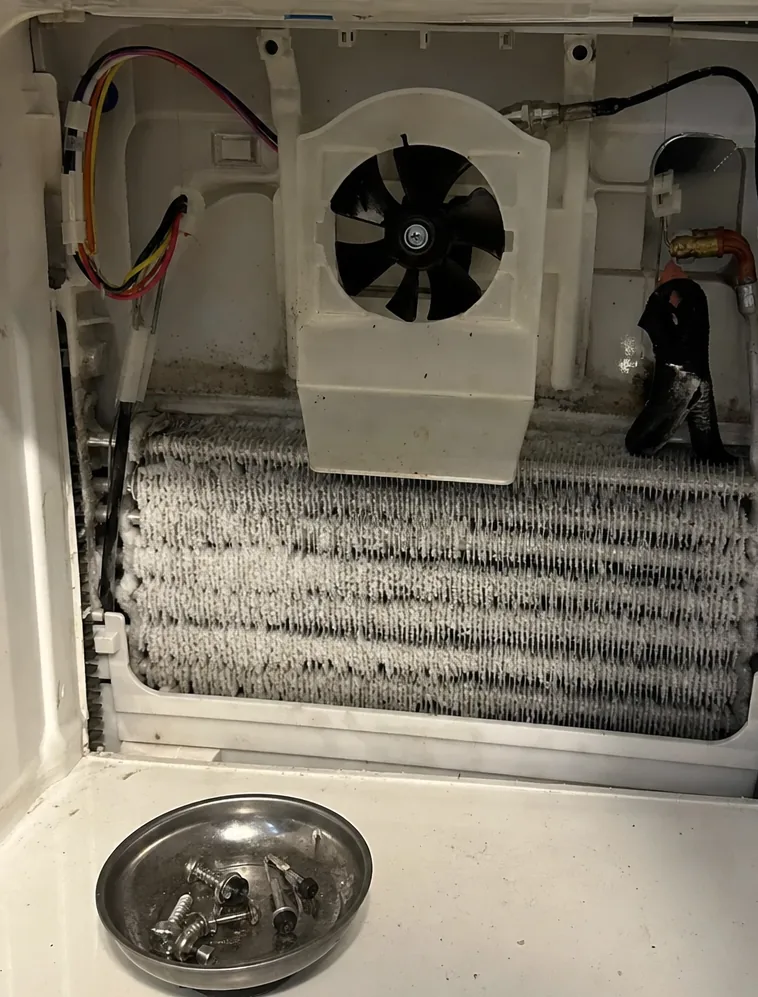
- Ice building behind the lowest freezer basket and locking it in place
- A column running noticeably longer than its twin on the same wall
A column is a single-purpose cabinet: all refrigerator or all freezer, built to sit flush in a run of cabinetry behind a door panel that matches everything else in the room. In the newer kitchens around Sawgrass Players Club and Marsh Landing they usually arrive in pairs, sometimes threes, and the whole point of the installation is that you cannot tell which is which until you open one.
That is a lovely thing to live with and a slightly awkward thing to service, because every fault has two layers. There is the refrigeration problem, and then there is the cabinetry problem sitting in front of it.
The condenser problem nobody sees
Every column rejects heat through a grille, and in an integrated installation that grille is normally at the top, behind a decorative panel that is part of the cabinet design rather than part of the appliance. Owners clean under the kick plate of a freestanding unit without thinking about it. Almost nobody takes down a matching maple panel above eye level.
On this coast that matters more than it would anywhere inland. The intake draws kitchen air that has come in through doors opening onto a pool deck less than a mile from the Atlantic, and that air carries salt. Aluminium fins hold it, moisture follows, and the fin pack slowly closes up with a chalky bloom that reads on your side of the door as nothing at all — until one column starts running longer than its neighbour.
Two identical columns on the same wall are the best diagnostic tool in the house. If one has quietly stopped cycling off and the other still does, you have narrowed the problem down before anyone arrives.
Doors, panels and the thing that is not a fault
A custom panel adds real weight to a door that was hinged and closed at the factory with a nominal panel in mind. Over a few years the hinge takes a set, the door stops pulling itself shut over the final half inch, and the seal touches on three sides instead of four. The cabinet then works harder, the evaporator ices unevenly, and the first thing you notice is frost along the top of a drawer front rather than anything as obvious as warm food.
Some of this is adjustment rather than repair. Hinge tension, panel alignment and closer travel are all serviceable, and a door-ajar alarm going off on a closed door is usually telling the truth about the last quarter inch even when your eye says otherwise. It is worth ruling that out before anyone starts talking about sealed systems.
Two cabinets, two systems
Because each column carries its own compressor, evaporator and defrost cycle, a fault stays where it starts. A freezer column that frosts heavily while the refrigerator column beside it is faultless is not a shared-system problem and does not need a shared-system repair. Diagnosis is a matter of establishing which of three things has changed inside that one cabinet: airflow across the evaporator, the defrost cycle’s ability to clear the coil, or the sealed system itself. They fail differently and they look similar from outside.
Freezer columns that include an ice maker add one more variable, because the ice maker has its own supply, its own fill valve and its own failure modes sitting inside a cabinet that is otherwise behaving normally. Light or hollow cubes from a freezer that is holding temperature correctly are an ice-maker fault, not a freezer fault, and the two are worth separating before any part is ordered.
How the visit runs
We take readings from both cabinets before opening anything, so the comparison is written down rather than remembered. The diagnostic is a flat fee, credited toward the repair once you approve it, and the written estimate comes before a panel is removed. Sealed-system work is carried out by EPA Section 608 certified technicians, because recovering refrigerant is regulated work.
Parts are genuine OEM and ordered against the serial plate inside the specific column, not the one next to it. Columns of the same width and the same year can carry different fan motors and different control boards, and the nearly-right part is the most reliable way to be back in the same kitchen in four months.
What the visit includes
- Removal and refitting of custom door panels without marking the joinery
- Readings taken from both cabinets so the two can be compared honestly
- Written estimate before any panel comes off or refrigerant is touched
- Genuine OEM parts ordered against the serial plate of that specific column
- 90 days on labour, 365 days on parts
From the journal
- Where to buy a Sub-Zero refrigerator, and what to check before you pay
Buy a new Sub-Zero fridge through a dealer listed on the brand's website. A used one, or one sold with a house, needs its serial tag and condition checked.
- Sub-Zero refrigerator reset button: what to press and what it tells you
A Sub-Zero refrigerator has no separate reset button: you reset it by turning it off at the panel or breaker, then on. What to check when that fails.
- A Sub-Zero fresh-food side warm, freezer still cold
One side warm and the other cold is a specific diagnostic clue. Here is the order faults should be eliminated in before anyone opens a sealed system.
What it costs
What does a Sub-Zero integrated column repair cost in Ponte Vedra Beach?
Most of this work lands between $250 and $2,340, parts and labour together, and the visit that decides which end of that you are at is a flat $80 credited to the repair once you approve it. The firm number is written down after the diagnosis, not guessed at over the phone.
| Work | Typical range |
|---|---|
| Diagnostic visit | $80 flat, credited to the repair |
| Evaporator or condenser fan motor | $250–$580 parts and labour |
| Electronic control board | $400–$820 parts and labour |
| Compressor or sealed-system repair | $860–$2,340 parts and labour |
| Defrost heater, thermostat or sensor | $250–$640 parts and labour |
Written estimate before anything is opened up. The invoice carries one number; a band is what can honestly be published before the cabinet is open. The full table is on the pricing page.
Customer reviews
After a sub-zero integrated column repair visit
4.8 out of 5 from 67 customer reviews. Each one below is a single visit, described by the person who paid for it.
Both columns lost power after a lightning event. He tested the supply, found one board with a burnt trace and replaced it, then advised where to fit protection so the pair are not left equally exposed.
Grant E.2025-10-23
The diagnosis was right and the column has been steady since the new fan motor went in. Getting an answer between visits was harder than it should have been, and I chased twice for a parts update.
Hollis U.2025-10-09
Both columns had been sluggish since we lost power for four days. He read the stored settings out of each one, found values that had reverted rather than a failed part, and set them back properly with nothing replaced.
Isolde B.2026-07-21
Questions we get asked
Answers before you call
- What does a Sub-Zero integrated column repair cost in Ponte Vedra Beach?
- Most of this work falls between $250 and $2,340, parts and labour together: evaporator or condenser fan motor runs $250–$580, electronic control board runs $400–$820, compressor or sealed-system repair runs $860–$2,340 and defrost heater, thermostat or sensor runs $250–$640. Which band your cabinet is in is what the diagnostic settles, and the figure on the written estimate is the one you are asked to approve.
- Is the $80 diagnostic charged on top of the repair?
- No. The $80 covers the visit and the whole diagnostic sequence, and it comes off the repair the moment you approve the work. Decide against it and the diagnostic is all you have spent: the written findings are yours to take anywhere you like. 90 days on labour, 365 days on parts, and genuine OEM parts on every repair.
- Why does one column drift while the column beside it holds?
- Because they are two separate appliances sharing a wall and a run of panels. Each has its own sealed system, its own defrost circuit and its own air intake hidden behind the joinery. When one drifts and its twin holds, the pair gives us a reference reading most kitchens cannot offer.
- Do the custom door panels have to come off?
- Often, and it is planned rather than improvised. Panels come off at the fixings they were hung on, are set down away from the work, and go back to the alignment they came off at. The joinery around a column is the expensive part of the room and it is treated that way.
- The door alarm sounds with the door plainly shut. What is that?
- The cabinet is not being told the door is closed. On a column the switch sits in the hinge stack, so a hinge that has dropped a fraction and a switch that has stopped reading both produce an alarm on a closed door. That is checked before anything more expensive is suspected.