October 26, 2026 · maintenance
How to get defrost water out of a fridge, and where it is supposed to go
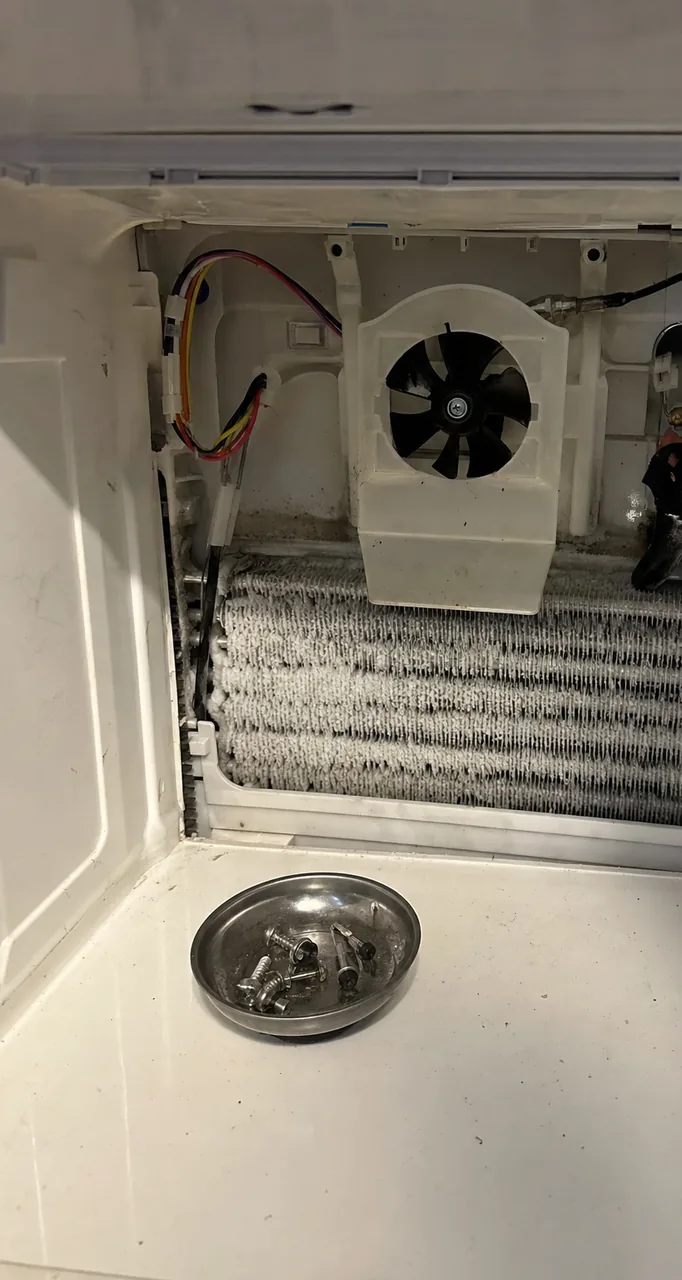
To remove defrost water from a fridge, soak up whatever has pooled with towels, then work out why it did not leave on its own. In a frost-free refrigerator, melt water is meant to run from a trough under the evaporator coil, through a small drain hole and tube, into a shallow pan near the compressor, where warm air dries it off. Water on a shelf, under the crisper drawers or on the floor almost always means that path is blocked, most often by a plug of ice or food debris in the drain. Clear the drain, check the pan, and the water usually stops.
Why frost forms in the first place
Each time a door opens, room air rolls in carrying moisture. The coldest surface in the cabinet is the evaporator coil, hidden behind a panel at the back of the freezer or fresh-food section, and that moisture freezes onto its fins as a thin white coat. Left alone, the frost would keep growing until air could no longer pass through the coil, and cooling would fade. Worn door seals, a door resting slightly ajar and warm dishes loaded uncovered all add to the load. In a Ponte Vedra Beach kitchen the outdoor air stays damp for most of the year, so a door held open while guests choose drinks brings in more water than you might expect.
How the defrost cycle clears it
A frost-free unit deals with this by itself. At intervals the control stops cooling and powers a heater fastened to the coil. A sensor or thermal switch ends the cycle once the coil warms past freezing, so the heater never runs longer than it should. The melt drips into a trough, leaves through a hole at the bottom of the coil cover and travels down a tube to the drain pan in the machine compartment. Compressor heat and the condenser fan dry that pan between cycles, which is why defrost water mostly ends up as invisible vapor in your kitchen.
A healthy pan holds a thin film of water or sits dry. On a built-in, that compartment hides behind a grille, so check your use and care guide before you go looking for the pan.
Clearing a blocked defrost drain
This is the part most owners can handle:
- Switch the unit off at its control or breaker and move the food into coolers.
- Find the drain opening, usually at the bottom of the evaporator cover inside the freezer, or beneath the crisper drawers on the fresh-food side.
- Melt any ice in the opening with warm water from a turkey baster or squeeze bottle.
- Keep flushing slowly until water runs freely, then wipe the trough and the floor of the cabinet dry.
Leave the doors open while you work, with towels down to catch the runoff. Once everything is dry, switch the unit back on and let it reach temperature before reloading.
Heavy ice: melt it, never chip it
The coil is thin tubing that carries refrigerant. One slip with a knife, screwdriver or ice pick can puncture it, and the charge leaks out. That turns a towel job into compressor or sealed-system work, typically in the $860–$2,340 range, with the firm figure set only after diagnosis.
Sub-Zero’s advice depends on the line. The Classic (CL) and Designer (DET, DEC) guides say to switch the unit off and melt heavy icing with a hair dryer on its low setting, kept moving. PRO Series owners get different instructions: reach for a handheld steamer, and leave the hair dryer in the bathroom. The USDA’s general guidance for manual defrosting warns against electric heaters and any sharp tool, since they can damage the inner liner. Follow the guide written for your model.
When the frost or water keeps coming back
| Symptom | Likely cause | What you can check | When to call |
|---|---|---|---|
| Water under the crisper drawers | Plugged drain | Flush the opening | It returns within weeks |
| Thick frost across the back wall | Heater, sensor or relay fault | Breaker reset only | After the reset fails |
| Frost along the door edge | Seal not closing | Clean the gasket | A gap remains |
Before wiping a seal, power the unit down. Soapy water on a soft rag handles everyday grime, baking soda mixed into a paste lifts heavier staining, and a 1:10 bleach solution deals with mildew; vinegar and rubbing alcohol stay off the rubber.
A display code narrows things down. On a current Classic (CL), 15 4 00 means the defrost relay is stuck open. On an older Designer unit, 20 4 50 means defrost ended on timeout four times running because the bimetal never tripped while the heater was on. For either, switch the breaker off for 30 seconds, as our reset button notes describe, then book service if the code returns. Defrost heater, thermostat or sensor repairs typically run $250–$640, with the firm price given after the $80 diagnostic. Our built-in refrigerator repair page covers the visit itself.
What it costs
What does a Sub-Zero a Sub-Zero defrost repair repair cost in Ponte Vedra Beach?
Most of this work lands between $250 and $640, parts and labour together, and the visit that decides which end of that you are at is a flat $80 credited to the repair once you approve it. The firm number is written down after the diagnosis, not guessed at over the phone.
| Work | Typical range |
|---|---|
| Diagnostic visit | $80 flat, credited to the repair |
| Defrost heater, thermostat or sensor | $250–$640 parts and labour |
Written estimate before anything is opened up. The invoice carries one number; a band is what can honestly be published before the cabinet is open. The full table is on the pricing page.
Customer reviews
Visits behind this note
4.8 out of 5 from 67 customer reviews. Each one below is a single visit, described by the person who paid for it.
The fresh food side sat at fifty two while the freezer held fine. He found the evaporator fan motor stalled behind a wall of frost and replaced it, then cleared the drain tube that had caused the ice.
Marla T.2026-07-28
The door alarm kept sounding with the door shut. It turned out to be a magnetic reed switch in the hinge column. The part sat on back order for a week, which was frustrating, but the fix itself was quick.
Colin W.2026-06-11
We came back from months away to a warm cabinet and a smell we could not place. He cleared the drain trough, replaced a check valve that had perished, and showed us how to leave the unit if the house sits empty again.
Delphine R.2026-09-09
Questions we get asked
About Sub-Zero a Sub-Zero defrost repair repair
- What does a Sub-Zero a Sub-Zero defrost repair repair cost in Ponte Vedra Beach?
- Most of this work falls between $250 and $640, parts and labour together: defrost heater, thermostat or sensor runs $250–$640. Which band your cabinet is in is what the diagnostic settles, and the figure on the written estimate is the one you are asked to approve.
- Is the $80 diagnostic charged on top of the repair?
- No. The $80 covers the visit and the whole diagnostic sequence, and it comes off the repair the moment you approve the work. Decide against it and the diagnostic is all you have spent: the written findings are yours to take anywhere you like. 90 days on labour, 365 days on parts, and genuine OEM parts on every repair.
- Where does defrost water go in a refrigerator?
- It ends up in your kitchen air. Melt from the evaporator coil runs through a drain hole and tube into a shallow pan in the machine compartment, and warmth from the compressor plus air from the condenser fan dry it off between cycles. Nothing has to be emptied when that path is clear.
- How do you unblock a defrost drain in a refrigerator?
- Switch the unit off, find the drain opening under the evaporator cover or below the crisper drawers, and melt any ice in it with warm water from a turkey baster. Keep flushing until water flows freely toward the pan. A drain that plugs again within a few weeks usually points to a defrost fault rather than debris.
- Should I leave the fridge open or closed when defrosting?
- Open, as long as the unit is switched off and the food is in coolers. Room air does the melting, and towels or a shallow tray catch the runoff. Once the cabinet is dry, close the doors, switch it back on and let it reach temperature before you reload it.
- How much water should be in a refrigerator drip pan?
- Very little. A thin film, or a pan that is dry, is normal, because the water evaporates between defrost cycles. A pan near the brim means more moisture is getting in than the unit can dry, often from a door seal that no longer closes tight, or that the condenser fan is not moving air over it.
- What temperature should the refrigerated section of a refrigerator be?
- Keep the fresh-food side at 40 degrees Fahrenheit or colder, and many owners set it to 38. Sub-Zero notes that a refrigerator reading above 48 while set at 38 is unlikely to come back with a condenser cleaning, so that reading calls for a service visit rather than more home fixes.
Related